
Atmospheric Perspective Explained: Show Depth with Haze
Learn how atmospheric perspective makes far hills paler, bluer and softer, then warm up your eye in the cube game below.
Play the Daromeon Cube Challenge
Ready to draw the missing cube?
Press Play when you are ready to draw. The game starts only after you choose to play.
Loading Daromeon…
Preparing your drawing challenge…
What Is Atmospheric Perspective?
Atmospheric perspective, also called aerial perspective, is the way air makes distant things look lighter, bluer and less sharp. Dust and water in the air scatter light, so every kilometre adds a thin veil of sky color in front of whatever sits behind it.
Artists use atmospheric perspective to show depth with tone and color instead of lines. Leonardo da Vinci wrote about it in his notebooks, and it still drives every landscape with a hazy horizon. Atmospheric perspective art works because your eye reads a pale, soft shape as far away.
Five Rules of Atmospheric Perspective
Every case of atmospheric perspective follows five rules. We computed each diagram from a haze model, so the numbers are measured, not guessed.
- 01
Values move toward the sky
Far objects take on the value of the sky behind them. Darks get lighter until they almost match it. In our diagram one green ridge goes from 32 to 84 percent light between 1 and 25 km, while the sky sits at 89. That climb is atmospheric perspective at work.
- 02
Colors turn cooler and duller
Air scatters violet-blue light about six times more than deep red, so the veil is usually blue. A red roof turns dull pink at 3 km and blue-gray at 12 km. In atmospheric perspective you paint the color of the air, not just a paler object.
- 03
Edges soften and detail drops
Near a tree you see single leaves and a crisp edge. A few kilometres away it is one soft shape. Draw near edges sharp and far edges soft, and leave out texture you could not really see. Missing detail is a depth cue on its own.
- 04
The weather sets the strength
Atmospheric perspective is not fixed. With 40 km of visibility, contrast halves about every 7 km. With 15 km of haze it halves every 2.7 km, and a ridge 10 km away keeps only 7 percent of its contrast. Decide the weather before you pick values.
- 05
It works with linear perspective
Linear perspective makes far things smaller; atmospheric perspective makes them paler. Use both and depth reads at a glance. A row of fence posts that shrinks toward a vanishing point and fades as it goes is the classic atmospheric perspective drawing.
Atmospheric Perspective Examples
These atmospheric perspective examples are easy to spot outside or in any landscape painting.
Mountain ranges
Each range behind the next is a step lighter and bluer. Count the steps and you have a ready value plan.
A city skyline in haze
On a humid or smoggy day, towers a few blocks back turn gray and lose their windows.
A forest in fog
Fog is atmospheric perspective at full strength: trees vanish into white within a few hundred metres.
Hills at sunset
Low sun turns the air orange, so distant hills fade toward warm colors instead of blue.
Linear vs Atmospheric Perspective
Linear and atmospheric perspective answer different questions. Use this table to see which one a flat drawing is missing.
| Feature | Linear perspective | Atmospheric perspective |
|---|---|---|
| Main tool | Lines and vanishing points | Value, color and edges |
| What changes | Size and angle | Lightness, hue and sharpness |
| Works on | Boxes, roads, buildings | Hills, skylines, any far form |
| Fails when | Edges miss the vanishing point | Far forms are as dark as near ones |
| Best drill | A cube or box | A three-value landscape study |
How to Draw Atmospheric Perspective in 5 Steps
This value plan works in pencil, paint or digital. The diagram uses a 1 to 10 pencil scale, where 10 is the darkest.
- Split the scene into near, middle, far and sky.
- Pick the sky value first; here it is a 2.
- Step each plane toward the sky: 9, 6, then 4.
- Keep the darkest darks and sharpest edges up front.
- Soften far edges and leave out far detail.
Warm Up the Linear Half in the Cube Game
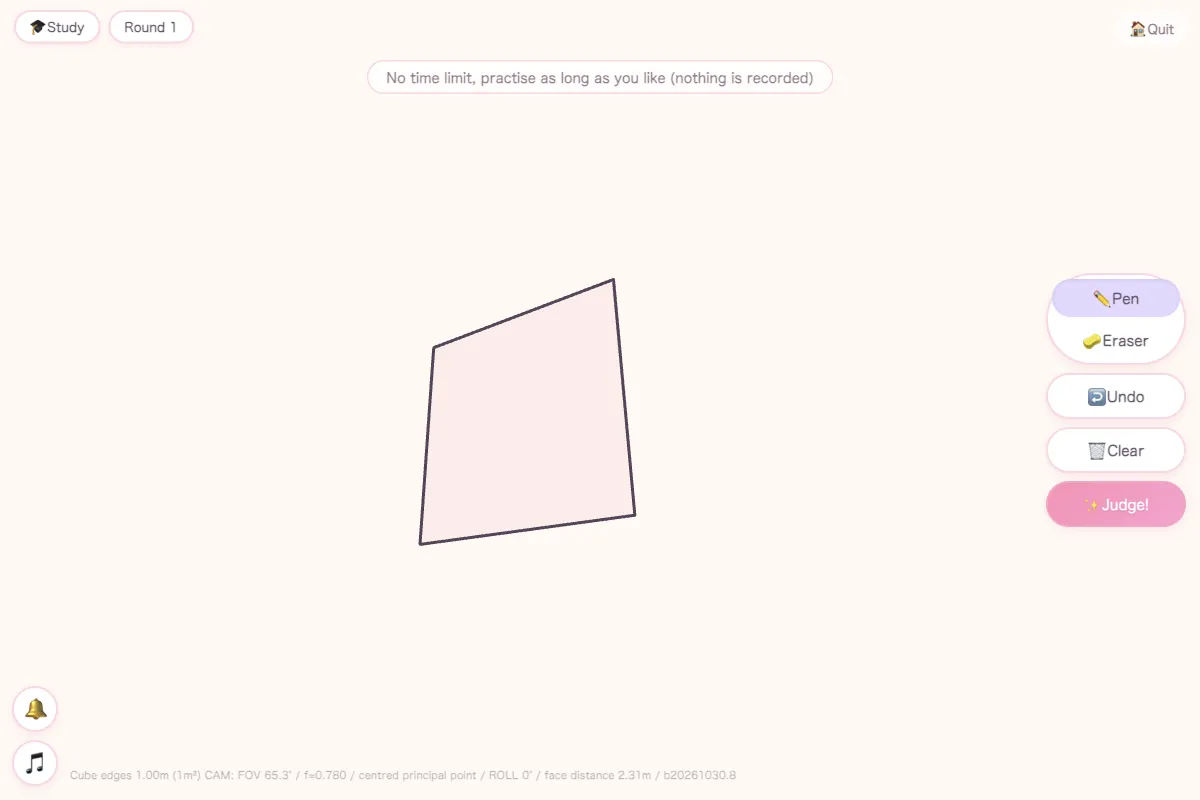
Atmospheric perspective handles tone, but a landscape still needs correct shapes. The Cube Challenge trains that linear half: each round shows one face of a cube in true 3D perspective, and you draw the missing edges.
The game grades only where edges go, not value or haze, so use it as a two-minute warm-up. Then switch to tone and build the atmospheric perspective on paper with the value plan above.
Jump back to the gameSame-Size vs Converging Edges: Real Scores
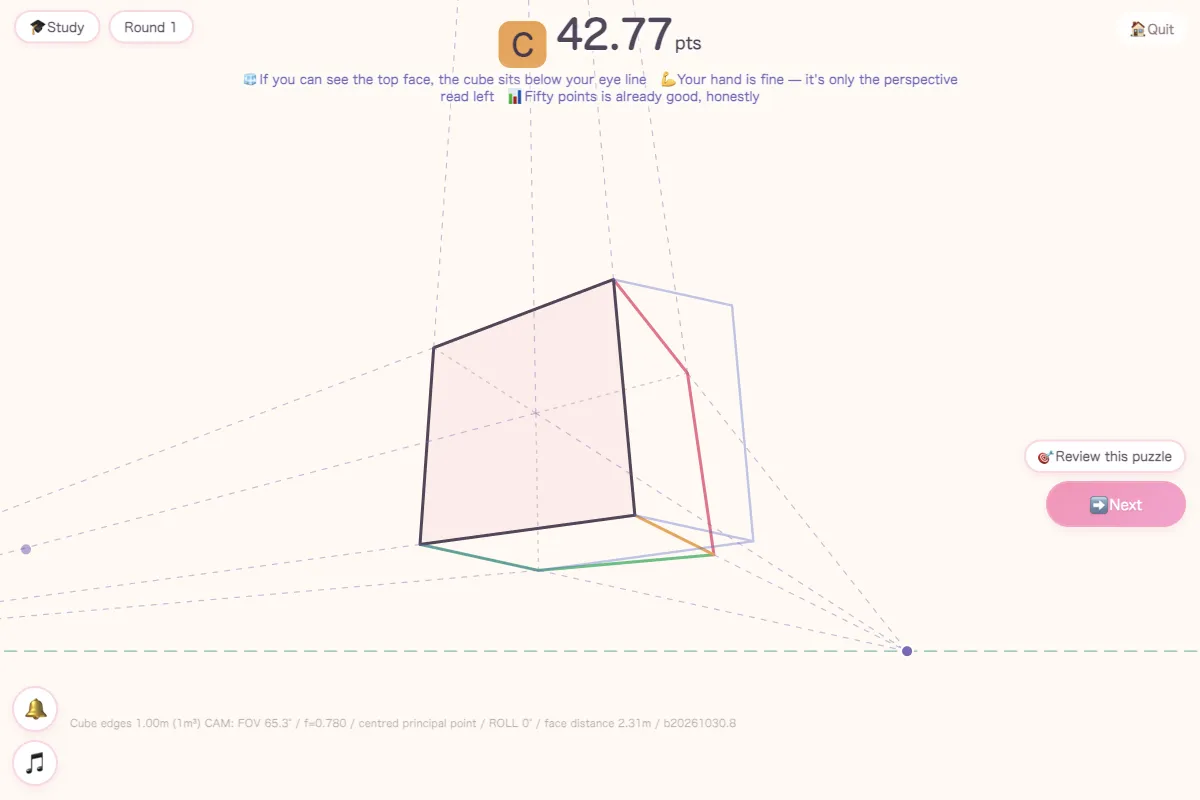
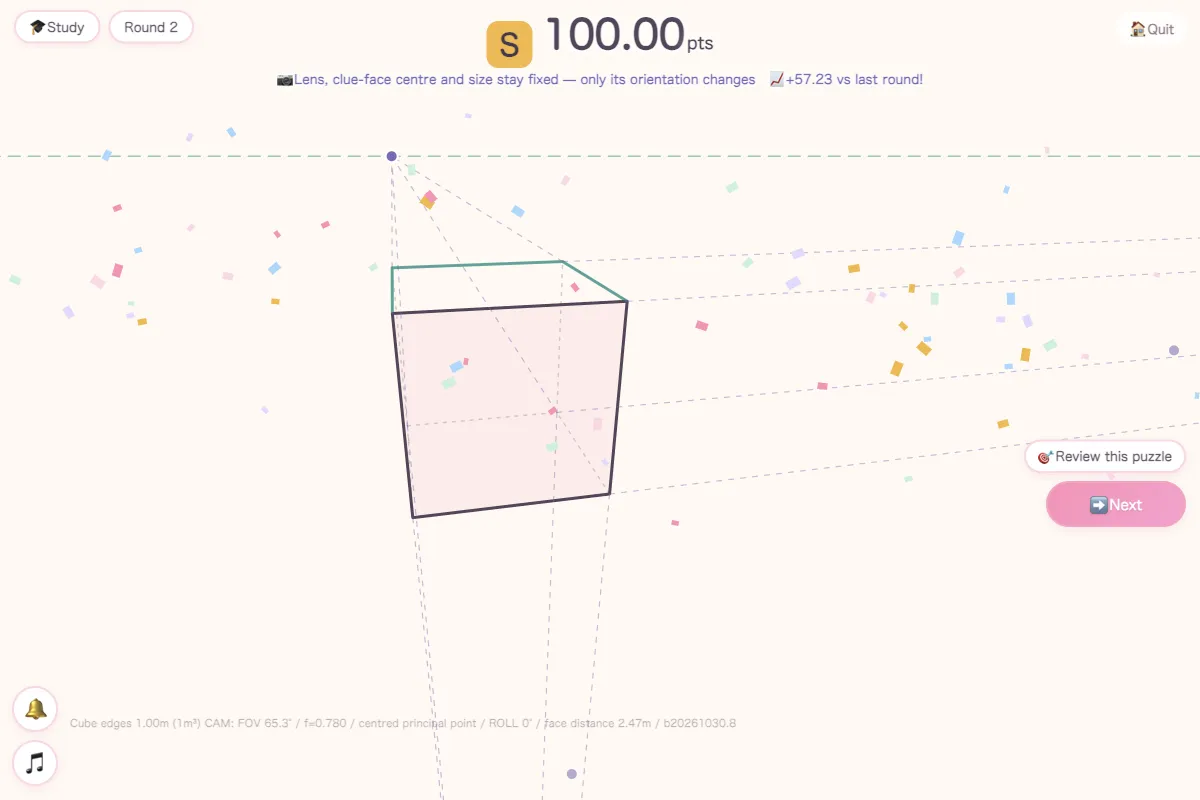
Atmospheric perspective cannot rescue shapes that are wrong. We drew two cubes in the game to show the linear side of depth.
How We Tested This Guide
We computed every color in the diagrams with Koschmieder’s law: contrast falls with distance as e to the power of minus beta times d, where beta is 3.912 divided by the visibility. A clear day uses 40 km of visibility; a hazy day uses 15 km.
On November 16, 2026, we played the Cube Challenge in untimed Practice mode. A cube with a same-size back face scored 42.77 (grade C). A cube with every edge placed on lines to its vanishing points scored 100.00 (grade S). Tested by the Daromeon team.
Limits: the haze model ignores glare, clouds and smoke, which can make far things darker or warmer. The game checks only straight cube edges, never value, color or atmospheric perspective, so practice those on paper.
Atmospheric Perspective: FAQ
What is atmospheric perspective in art?
It is a technique that shows distance by making far objects lighter, cooler, lower in contrast and softer at the edges. Artists copy what air does to light. Landscape painters from Leonardo da Vinci to today use atmospheric perspective to push mountains back without drawing a single line.
Is aerial perspective the same as atmospheric perspective?
Yes. Aerial perspective is the older name for the same effect, and art books use both terms. It has nothing to do with views from a plane or a drone; “aerial” refers to the air between you and the subject.
What are the three rules of atmospheric perspective?
Most teachers sum it up in three rules: far objects get lighter, far colors get cooler and duller, and far edges get softer with less detail. This guide adds two more: the weather sets how strong atmospheric perspective is, and it works best together with linear perspective.
Why do distant mountains look blue?
Air scatters short blue wavelengths far more than long red ones, so the light added along a long line of sight is mostly blue. The farther the mountain, the more of that blue veil sits in front of it. At sunset the light crosses more air and the veil turns orange.
How do you show atmospheric perspective with only a pencil?
Plan values. Pick a light value for the sky, the darkest for the foreground, and two or three steps in between. Use a hard pencil and light pressure for far planes and a soft pencil up front. Blend far edges and keep crisp texture only close to you.
Does atmospheric perspective work indoors or in portraits?
Only weakly. A room holds too little air for real haze, so painters fake it with lower contrast and softer edges on the back wall. In a portrait, softening the background has the same pushing-back effect. Keep it subtle, or the scene will look foggy.
Ready to Warm Up Before a Landscape?
Open the cube game, draw the missing edges, and get your shapes right before you add atmospheric perspective.