
Cross Contour Drawing Explained: Lines That Wrap Around Form
Learn how cross contour drawing turns a flat outline into a round form, then warm up your 3D sense in the cube game below.
Play the Daromeon Cube Challenge
Ready to draw the missing cube?
Press Play when you are ready to draw. The game starts only after you choose to play.
Loading Daromeon…
Preparing your drawing challenge…
What Is Cross Contour Drawing?
Cross contour drawing is a technique where you draw lines that travel across the surface of a form, as if bands were wrapped around it, instead of only tracing the outer edge. Each line is a cross section: the curve you would see if a thin, flat slice cut through the object.
That is the whole cross contour drawing definition, and it explains why the method works. An outline only tells your eye where a shape stops. Cross contour lines tell it how the surface bends in between, so a circle becomes a ball and a rectangle becomes a can. Cross contour drawing is also called cross contour line drawing, or cross contour lines drawing in some art classes.
Five Rules of Cross Contour Drawing
Every good cross contour drawing follows the same five rules. We computed each diagram from a 3D model, so the curves and numbers are measured, not guessed.
- 01
Every line is a slice
Imagine slicing the form with flat, evenly spaced planes. Where each plane meets the surface you get one cross contour. On a vase the slices are wide at the belly and small at the neck, so the rings change size with the form. In cross contour drawing you draw the slice, not a decoration.
- 02
Spacing tightens where the form turns away
Lines that are evenly spaced on the object bunch up near the edge. On our sphere, rings every 20 degrees leave a gap of 34 percent of the radius at the middle but only 12 percent near the top, almost three times tighter. That squeeze is what makes a cross contour drawing look round.
- 03
Ellipse width shows the tilt
A ring seen from above is an ellipse, and its fullness tells the viewer the angle. Viewed 15 degrees from above, a ring is 0.26 times as tall as it is wide; at 30 degrees it is 0.50; at 60 degrees, 0.87. Keep that ratio steady on one form or the cross contour drawing will twist.
- 04
Rings stay square to the axis
Draw a light center line through every tube first. Each ring must cross that line at a right angle, so on a bent arm, finger or hose the rings turn as the axis turns. Rings that all stay level make a bent tube look flat, the most common cross contour drawing mistake.
- 05
Line weight follows the light
In cross contour drawing, the lines double as shading. In our diagram the light comes from the upper left, and the lines grow from 0.6 to 3.2 pixels thick as the surface turns away from it, about five times heavier on the shadow side. Thin lines read as light; heavy lines read as shade.
Cross Contour Drawing Examples
These cross contour drawing examples run from easy to hard. Start with the fruit and save the hand for last.
A pear or an apple
An easy cross contour drawing: one axis, one outline and seven rings that swell at the belly.
A vase or a bottle
A form turned on a wheel, so every ring sits square to one straight axis.
Folded fabric
Lines run across the folds, rising over each ridge and dipping into each valley.
A hand
For a cross contour drawing hand study, treat each finger as a tube with its own bent axis.
Contour vs Cross Contour Drawing
Contour drawing and cross contour drawing sound alike but do opposite jobs. Hatching is the third tool people often mix them up with.
| Feature | Contour drawing | Cross contour drawing | Hatching |
|---|---|---|---|
| Line follows | The outer edge | The surface, across the form | One straight direction |
| Shows | Shape and silhouette | Volume and tilt | Value only |
| Best for | Observation and gesture | Round and organic forms | Flat planes and quick tone |
| Common mistake | Stiff, traced lines | Rings not square to the axis | Lines that ignore the form |
| Good drill | Blind contour of your hand | Rings on a pear or a bottle | A five-step value scale |
How to Do Cross Contour Drawing in 5 Steps
This easy cross contour drawing routine works on any round object. The diagram uses a bottle.
- Draw a light center line through the form.
- Block in the outline around that axis.
- Draw the middle ring first, square to the axis.
- Add rings above and below; make them fuller as they move away from eye level.
- Add short, close lines on the shadow side.
Train the Box Under Every Form in the Cube Game
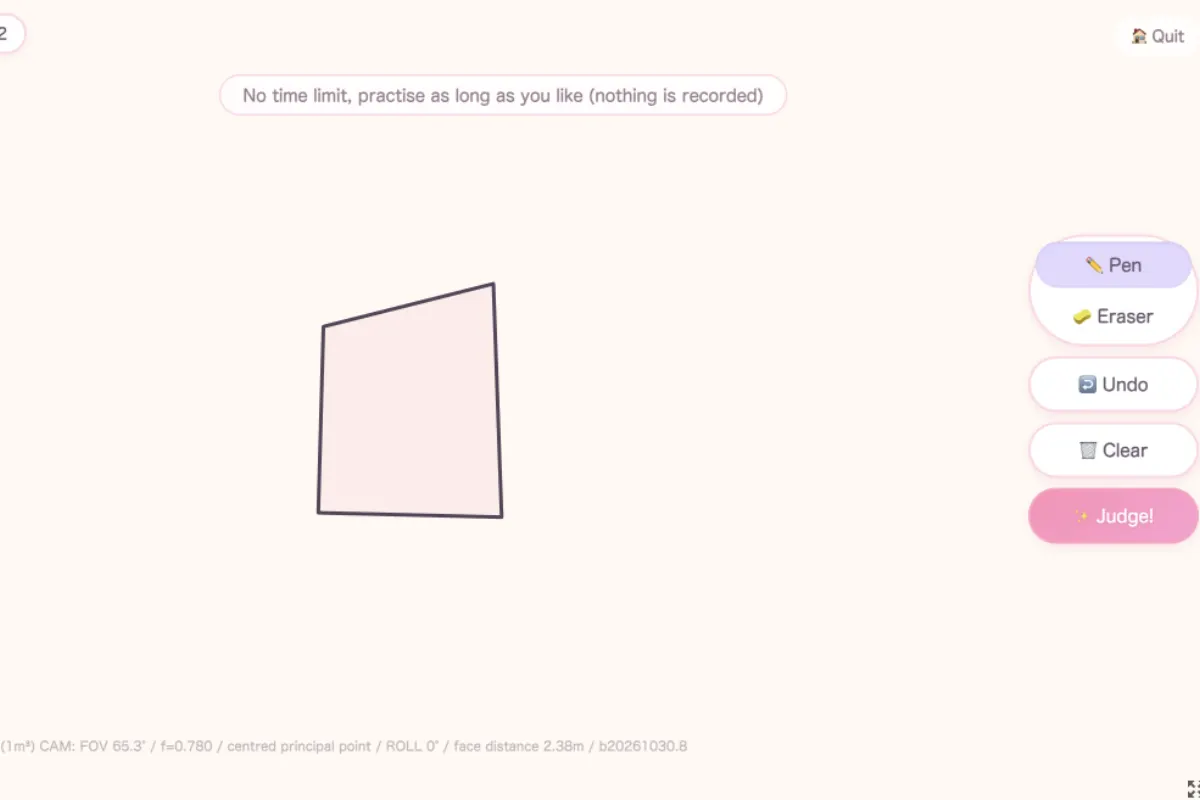
Every round form sits inside a box, and the rings of a cross contour drawing follow that box: a ring on a can is a square face turned into an ellipse. The Cube Challenge trains that box. Each round shows one face of a cube in true 3D perspective, and you draw the missing edges.
The game grades only where straight edges go, not curves or line weight, so use it as a two-minute warm-up. Then pick up a pencil and start a cross contour drawing of a pear or a bottle with the five steps above.
Jump back to the gameParallel vs Converging Edges: Real Scores
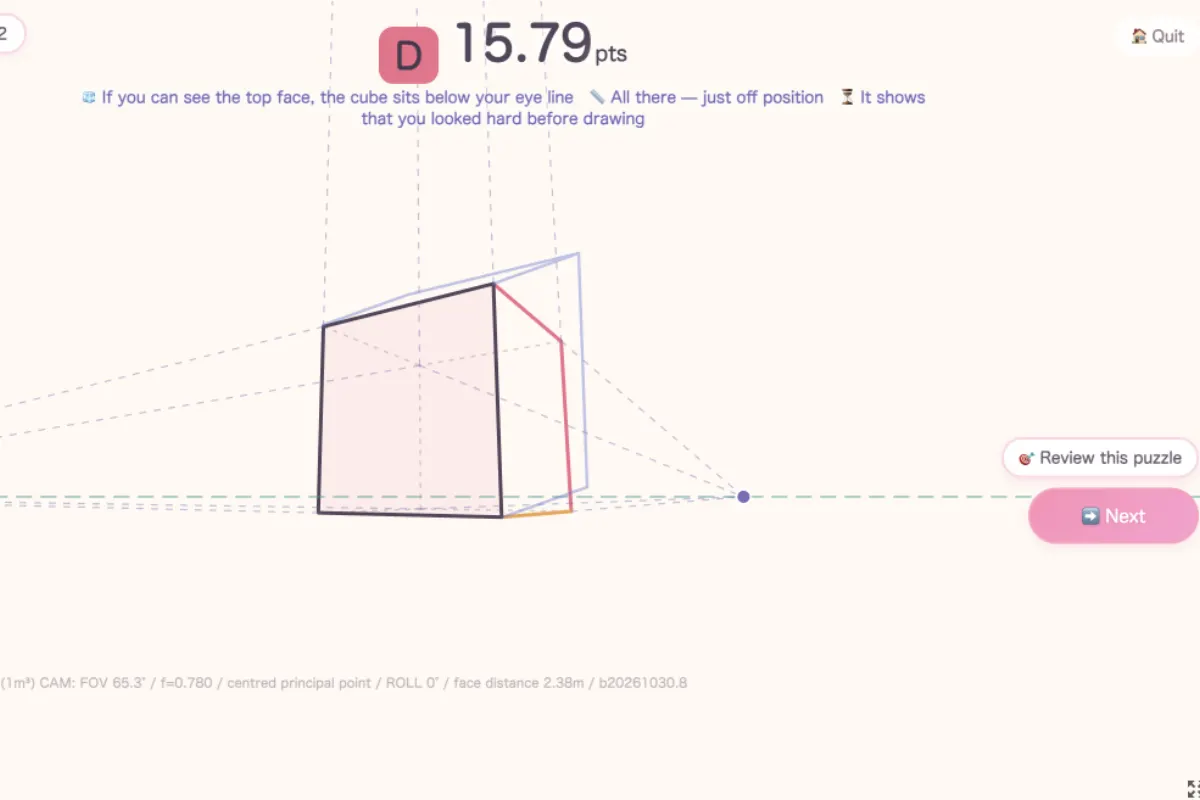
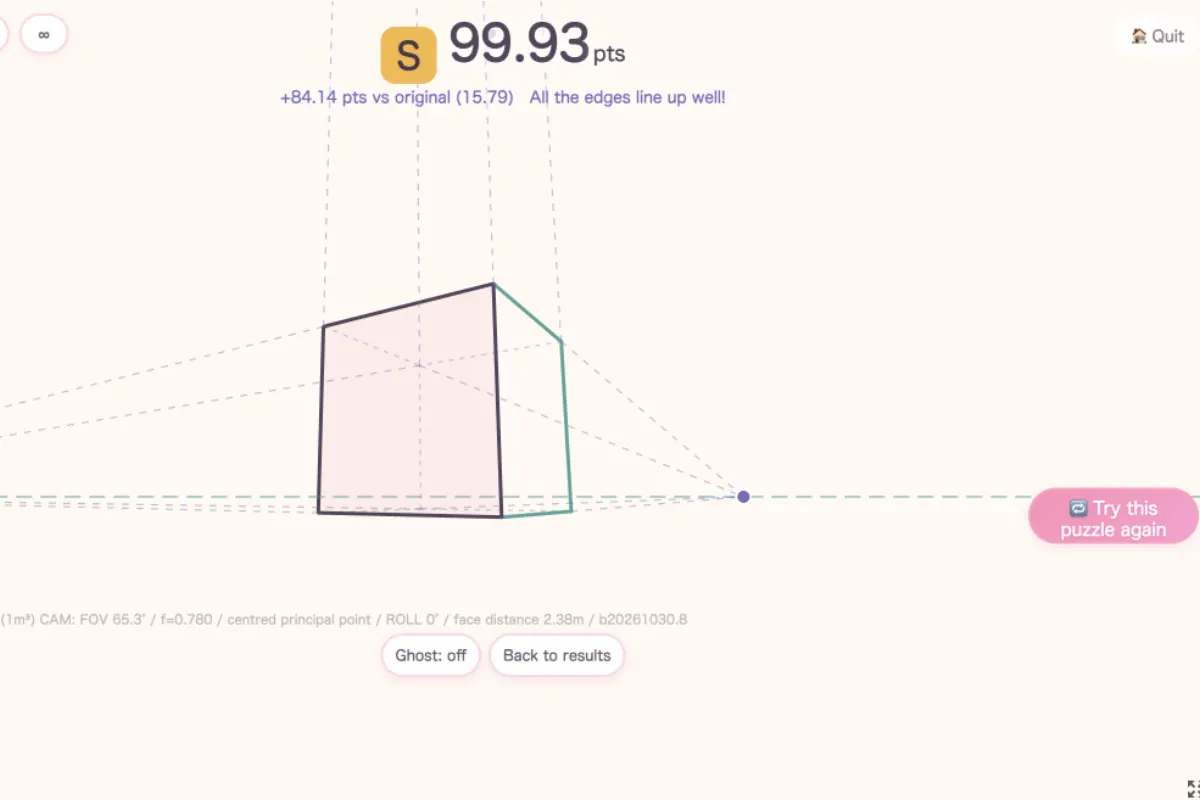
The rings in a cross contour drawing sit on the planes of a box, so the box has to be right first. We drew the same puzzle twice in the game.
How We Tested This Guide
We built every diagram from a 3D model. Points on each surface were projected with a camera tilted 15 to 60 degrees, hidden parts were dashed, and the line weights in rule 5 follow Lambert shading with light from the upper left. The gaps, ellipse ratios and weights quoted above are printed by that script.
On November 20, 2026, we played the Cube Challenge in untimed Practice mode. A cube with a same-size back face scored 15.79 (grade D). Redrawn in Review mode with each depth edge on its line to the vanishing point, the same puzzle scored 99.93 (grade S). Tested by the Daromeon team.
Limits: the diagrams use a parallel camera, so objects very close to you will show slightly fuller far rings than drawn here. The game checks only straight cube edges, never curves, so practice cross contour drawing itself on paper.
Cross Contour Drawing: FAQ
What is cross contour drawing in art?
It is a drawing method in which lines travel across a form rather than around its edge. Each line follows the surface the way a ribbon or a slice would, so the viewer reads volume, tilt and curvature from the lines alone. Artists use cross contour drawing for figures, fruit, fabric and any organic form.
What is the difference between contour and cross contour drawing?
A contour drawing traces the edges of a shape, inside and out. A cross contour drawing adds lines that cross the form from edge to edge, like the lines on a map of hills turned on its side. The first shows where the shape stops; the second shows how it is built in between.
How do you draw cross contour lines that look right?
Find the axis, then draw each line square to it. Space the lines evenly on the object, which means they bunch up near the edges on paper. Keep every ellipse on one form at a similar fullness, and draw only the front halves firmly.
How do you do a cross contour drawing of a hand?
Break the hand into a palm block and five tubes. Give each finger its own center line, bent at the knuckles, and wrap three or four rings around each segment. Rings on the palm run across the back of the hand like a curved roof.
Is cross contour drawing the same as cross hatching?
No. Cross hatching uses straight, crossing lines to build tone and ignores the form. Cross contour lines bend with the surface. You can combine them: hatch with lines that follow the cross contours, and the shading will describe the shape as well as the light.
What should a beginner draw first?
Start with an egg, a pear or a bottle, because each has a single straight axis. Draw five rings and check that their gaps shrink toward the edges. Move on to a bent tube, then a shoe or a hand, once the rings stay square to the axis.
Ready to Wrap Your First Form?
Warm up in the cube game, then pick up a pencil and give a pear or a bottle its first cross contour drawing.