
Oblique Drawing Explained: True Front, Parallel Depth
Learn how oblique drawing keeps the front face true and slants depth back at one angle, then test your eye below.
Play the Daromeon Cube Challenge
Ready to draw the missing cube?
Press Play when you are ready to draw. The game starts only after you choose to play.
Loading Daromeon…
Preparing your drawing challenge…
What Is Oblique Drawing?
Oblique drawing is a way to show a 3D object in which the front face is drawn at its true shape and size, and the depth edges run back at one fixed angle, usually 45 degrees. All depth edges stay parallel, so they never meet at a vanishing point.
Technical drawing classes call it oblique projection, oblique projection drawing or an oblique pictorial drawing. It is the quickest pictorial view to build with a ruler and a set square, which is why oblique drawing still shows up in design sketches, patent drawings and school worksheets.
Five Rules of Oblique Drawing
Every oblique drawing follows five rules. Each diagram below was computed from the same projection formula, so the angles and ratios are exact.
- 01
The front face keeps its true shape
Anything on the front plane is drawn exactly as it is: squares stay square and circles stay circles. That is the big advantage of oblique drawing. On an isometric cube the same circle becomes an ellipse only 0.58 times as wide as it is long, so you need an ellipse guide.
- 02
Depth lines stay parallel
In oblique drawing every depth edge runs at the same angle and never converges. That makes it easy to measure, but it is not how eyes or cameras see. Long objects seem to widen toward the back, because real perspective would have shrunk them.
- 03
Cavalier or cabinet sets the depth
Cavalier projection draws depth at full length, and a cube looks about twice as deep as it should. Cabinet projection draws depth at half length, which reads as a true cube. Unless a worksheet asks for cavalier, use cabinet for a natural oblique drawing.
- 04
The angle decides what you see
The receding angle is a choice. At 30 degrees a half-depth cube shows 0.43 of an edge on the side and 0.25 on top; at 45 degrees both show 0.35; at 60 degrees the top grows to 0.43. Pick the angle that shows the face with the most detail.
- 05
Put the long or round side in front
Distortion grows with depth, so turn the object until its longest side or its circles sit on the front plane. A bar three units long looks stretched when it runs back; turned sideways, the same oblique drawing keeps its true length.
Oblique Drawing Examples
These oblique drawing examples show where the method shines: objects with one important flat face.
A cabinet with drawers
The furniture that gave cabinet oblique its name: drawer fronts stay true rectangles.
Block letters
Draw the letter flat, then pull every corner back at 45 degrees for instant 3D type.
A pipe flange
Every bolt hole is a true circle, drawn with a compass instead of an ellipse guide.
A house with a gable
Put the gable end in front and let the roof run back; the door keeps its real proportions.
Oblique vs Isometric vs Perspective
Isometric vs oblique is the comparison most students need. Perspective is added because it is what the eye really sees.
| Feature | Oblique drawing | Isometric drawing | Perspective |
|---|---|---|---|
| Front face | True shape and size | Turned, edges at 30 degrees | Shrinks with distance |
| Depth lines | Parallel, at 30 to 60 degrees | Parallel, at 30 degrees | Meet at vanishing points |
| Depth scale | Full (cavalier) or half (cabinet) | Same as width and height | Changes with distance |
| Circles on the front | True circles | Ellipses (0.58) | Ellipses that vary |
| Best for | Quick sketches with one detailed face | Technical views with all faces equal | Realistic scenes |
How to Draw an Oblique Cube in 5 Steps
This cabinet oblique drawing needs only a ruler. The diagram marks each step.
- Draw the front face as a true square.
- From three corners, draw light lines at 45 degrees.
- Mark half the edge length on each line.
- Join the marks to finish the back edges.
- Show hidden edges as light dashes, or erase them.
Test Your Eye: Oblique vs Perspective in the Cube Game
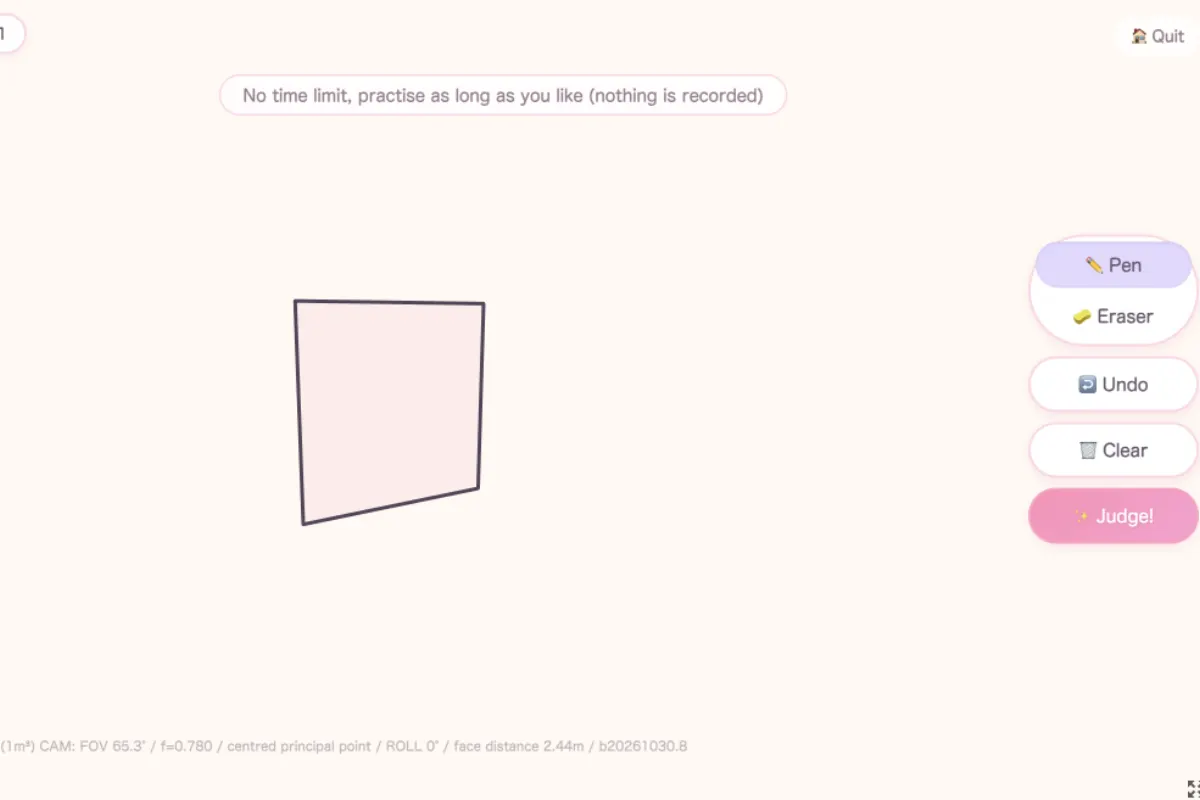
The Cube Challenge draws every cube in true 3D perspective, so it is a good way to feel how oblique drawing differs from what a camera sees. Each round shows one face of a cube, and you draw the missing edges.
Try one round in oblique style and one with every edge aimed at its vanishing point, then compare the scores. After that, go back to paper: oblique drawing is still the right tool for quick, measurable sketches.
Jump back to the gameOblique vs Perspective: Real Scores
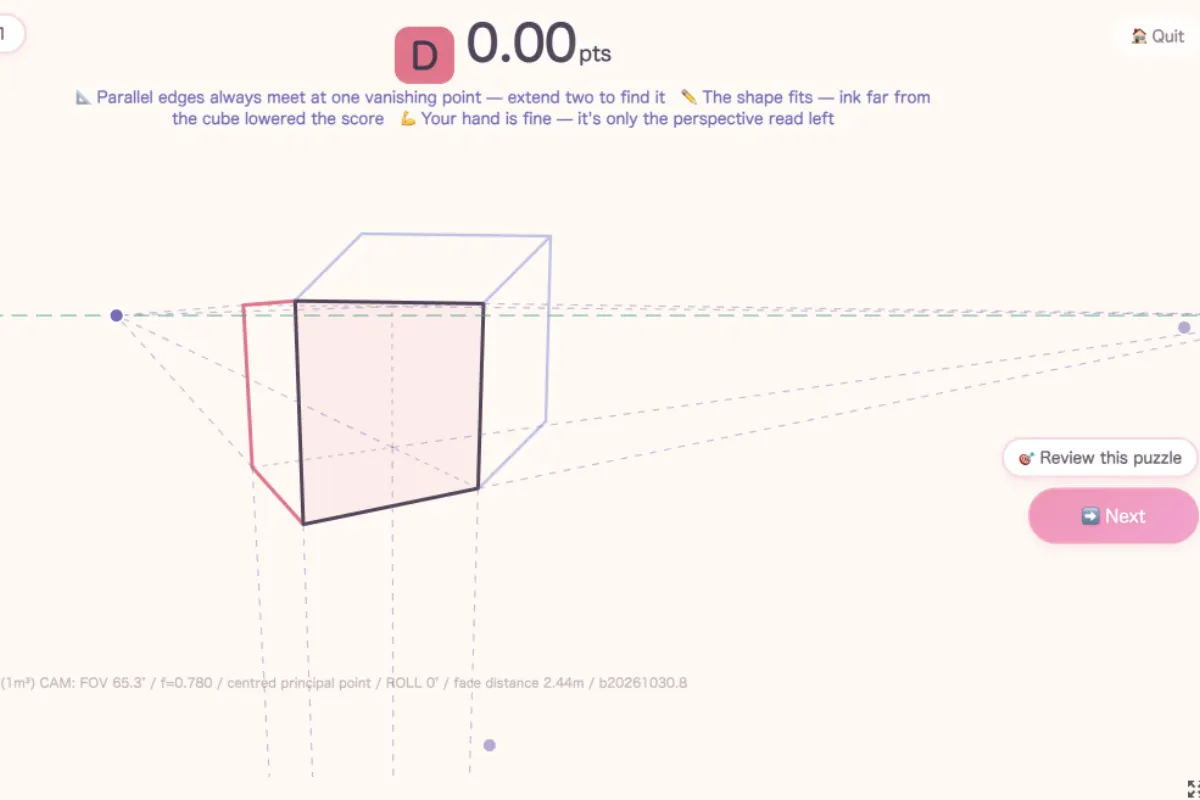
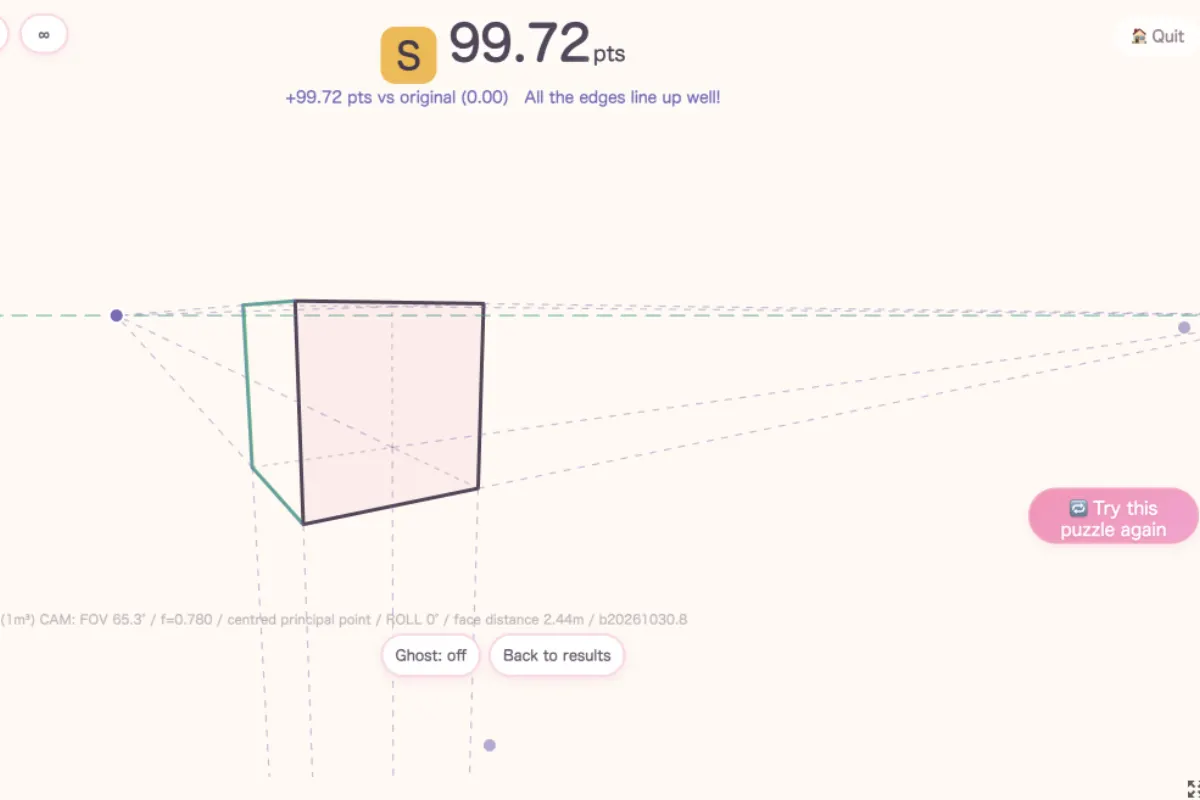
We drew the same puzzle twice: once as a cabinet oblique drawing, once in true perspective.
How We Tested This Guide
We built every diagram from the oblique projection formula: a point at depth z moves k times z along the receding angle, with k equal to 1 for cavalier and 0.5 for cabinet. The isometric circle ratio of 0.58 and the face shares in rule 4 come from the same script.
On November 20, 2026, we played the Cube Challenge in untimed Practice mode. A cabinet oblique drawing of the cube, with parallel depth edges up and to the right, scored 0.00 (grade D) because the real cube went back to the left. Redrawn in Review mode with every depth edge on its line to the vanishing point, the same puzzle scored 99.72 (grade S). Tested by the Daromeon team.
Limits: oblique drawing is a convention, not a view of reality, so a perspective game will always score it low. Use it for clear construction sketches, and switch to perspective when the picture must look real.
Oblique Drawing: FAQ
What is oblique drawing in technical drawing?
It is a pictorial view in which the front of an object is drawn true to size and the depth edges run back at a fixed angle. It is quick to build with drawing instruments and shows one face without distortion, so oblique drawing suits parts with round holes or detailed fronts.
What is the difference between oblique and isometric drawing?
In oblique drawing the front face is flat to the viewer and keeps its true shape, while depth runs back at an angle. In isometric drawing the object is turned so three faces show equally, with every edge at 30 degrees, and circles become ellipses on every face.
What is the difference between cavalier and cabinet oblique?
Both use the same angle. A cavalier oblique drawing keeps depth at full length; a cabinet oblique drawing cuts it to half. Cabinet looks more natural, while cavalier is easier to measure because every edge uses the same scale.
What angle is used in oblique drawing?
45 degrees is the standard, but any angle from about 30 to 60 degrees works. A lower angle shows more of the side; a higher angle shows more of the top. Keep one angle for the whole oblique drawing.
Is an oblique sketch the same as oblique drawing?
Yes, an oblique sketch is a freehand oblique drawing. Keep the front face square to the page, judge the 45 degree lines by eye, and shorten depth to about half. Graph paper makes it easy.
Is oblique drawing a type of perspective?
No. Perspective makes depth lines meet at vanishing points and objects shrink with distance. Oblique drawing is a parallel projection: depth lines never meet and nothing shrinks. That is why our oblique cube scored 0.00 in a perspective game.
Ready to Compare Oblique and Perspective?
Draw one cube the oblique way and one in perspective in the cube game, then keep the method that fits your sketch.